
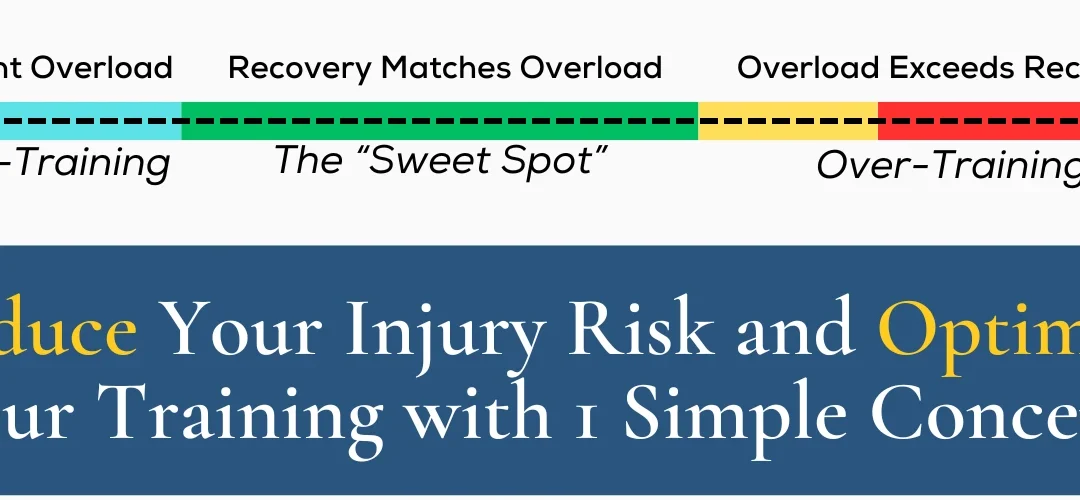
1 Training Concept to Rule Them All: Acute to Chronic Workload Ratio
Whether you’re a weekend warrior, barbell athlete, or dedicated runner, balancing your recovery and training intensity is crucial for improving performance and avoiding injury.
One of the most effective ways to monitor and adjust your training is through the Acute to Chronic Workload Ratio (ACWR).
This blog post will explain what ACWR is, why it’s important, and how you can apply it to your training.
What is ACWR?
- The Acute to Chronic Workload Ratio (ACWR) is a measure of your training fatigue.
ACWR is used to compare an athlete’s recent training load (acute) to their longer-term training load (chronic) to quantify the “pace” of progression.
- Acute Workload: The training load from the last 7 days. It represents the short-term workload.
- Chronic Workload: This is the average training load over the past 4 to 6 weeks. It represents the long-term workload.
The ACWR is calculated by dividing the acute workload by the chronic workload.
For example, if an athlete ran 18 miles in the past week (acute workload) and averaged 16 miles per week over the past four weeks (chronic workload), the ACWR would be 1.125 (18 miles / 16 miles).
This means the athlete’s workload increased by 12.5% compared to their longer-term average.
Why is ACWR Important?
ACWR helps balance training and recovery to reduce the risk of injury while optimizing performance.
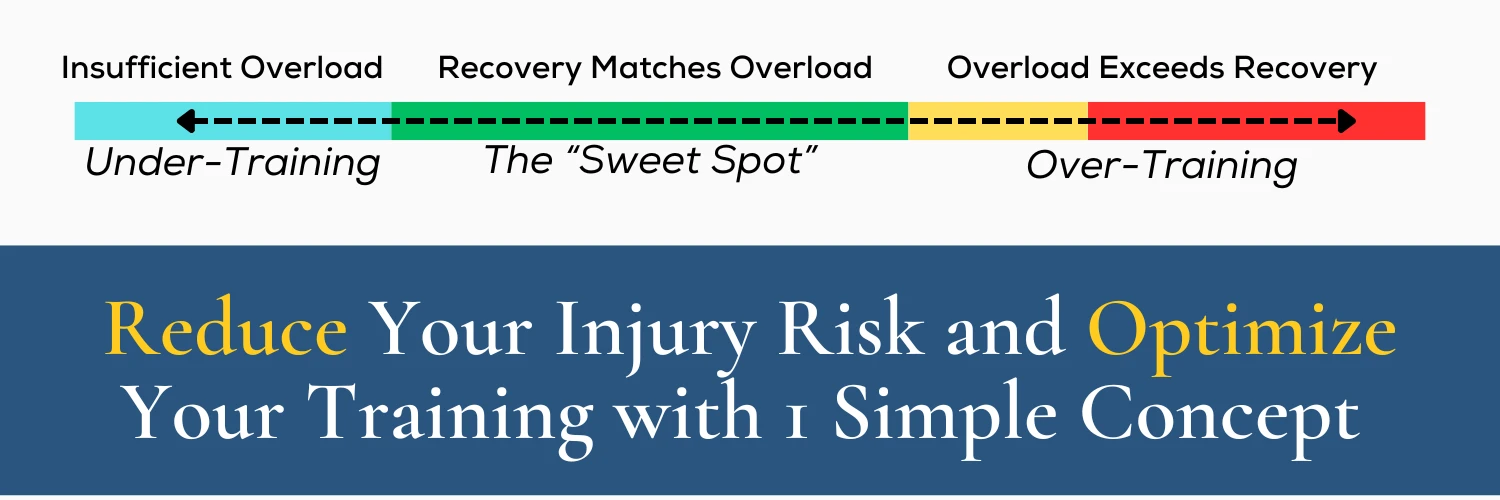
A high ACWR indicates that you are training with too much intensity or volume relative to your prior training averages, thus increasing the risk of injury.
Conversely, a low ACWR suggests under-training because the acute training load does not offer enough stimulus for improvement.
Research suggests that maintaining an ACWR in the range of 0.8 to 1.3 is associated with the lowest risk of injury, often referred to as the “sweet spot”.
Ratios above 1.5 can significantly increase injury risk, especially when combined with high chronic workloads.
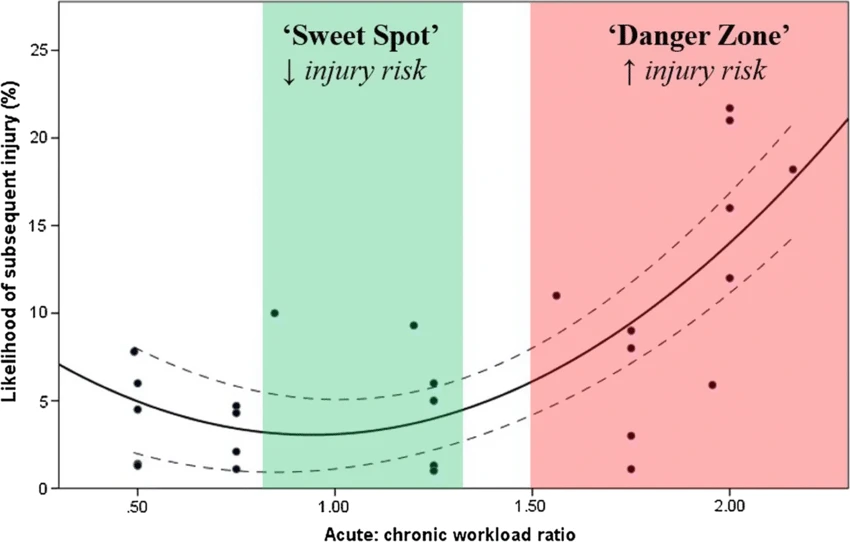
The Sweet Spot & Danger Zones of ACWR. Source: Wang et al 2020.
Applying ACWR to Your Training
Now to be realistic, you don’t have to calculate your ACWR every time you train.
I suggest my clients review their ACWR only once they find themselves hitting plateaus for 6-8 weeks, or if they are experiencing pain with training for greater than 4 weeks.
This does mean that you have to track your training, which is a good practice for anyone looking to optimize their fitness.
For runners, cyclists and endurance athletes this would be your weekly mileage or weekly aerobic minutes. For lifters, the number of intense working sets is sufficient, though volume (Sets x Reps X Resistance) is more specific.
Once you start to struggle, then you (or your physical therapist) will have some data to look at.
So in Summary:
- Track Your Training Loads for General Fitness Purposes: Record your daily training load, which can be measured in distance, active minutes, sets, training volume, or rating of perceived exertion (RPE).
- Calculate Acute and Chronic Loads if You Find Yourself either a) In a Training Plateau or b) Having Pain with Training: Determine your acute load (past 7 days) and chronic load (past 28 days).
- Compute Your ACWR: Simply divide the acute load by the chronic load.
- Monitor and Adjust Training Accordingly: Aim to keep your ACWR in the optimal range (0.8 to 1.3). Adjust your training plan if your ratio exceeds 1.5 or falls below 0.8.
Sources:
- Wang, Chinchin & Vargas, Jorge & Stokes, Tyrel & Steele, Russell & Shrier, Ian. (2020). Analyzing Activity and Injury: Lessons Learned from the Acute:Chronic Workload Ratio. Sports Medicine. 50. 10.1007/s40279-020-01280-1.
- Hulin, B.T., et al. (2016). The acute workload ratio predicts injury: high chronic workload may decrease injury risk in elite rugby league players. British Journal of Sports Medicine.
- Maupin, D., et al. (2024). Title of Study on ACWR in Runners. Journal of Sports Science.