
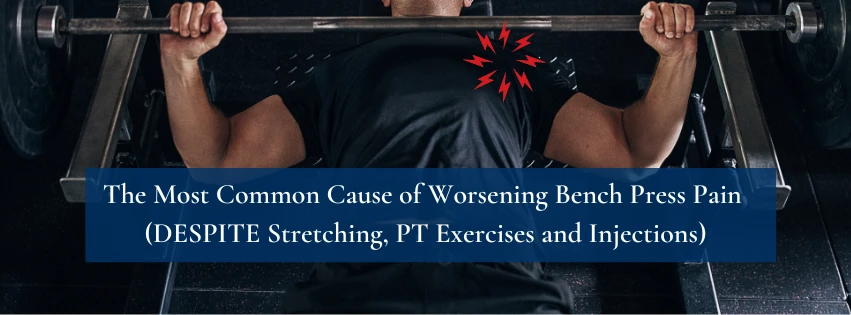
I treat a lot of weight lifters with anterior shoulder pain.
Over one hundred in the past year alone.
I’m rarely the first clinician they see for the injury. Fortunately, I am the last stop for >95% of the cases I’ve seen in the past year.
Many lifters are frustrated with chronic shoulder pain despite repeated efforts to seek advice and treatment.
They feel like they are on a hamster wheel from hell.
In fact, the average lifter I treat has the following track record:
- They’ve seen a primary care physician and an orthopedic surgeon.
- They’ve seen 1 or more physical therapists and/or chiropractors.
- They’ve wasted $3,000 – $6,000 on imaging, injections and treatments that have not worked (not to mention the wasted hours).
- They’re considering surgery as a “final option.”
That’s what I want to talk about the most common cause I see for persistent bench press that is worsening despite…
- Taking 4-6+ weeks off (only for pain to return as soon as you put real weight on the bar again)
- Trying oral NSAIDs, a steroid taper, and maybe even an injection (or 3)
- Doing the “best” shoulder stretches and exercises on IG and Youtube
- Trying physical therapy and/or chiropractic care for 10+ sessions
Insertional Pectoralis Minor Tendinopathy: An Underappreciated Cause of Anterior Shoulder Pain during the Bench Press
Most weightlifters with anterior shoulder pain are diagnosed with one of the following:
- Impingement Syndrome
- Rotator Cuff Tendinitis / Partial Rotator Cuff Tears
- Bicipital Tendinitis
- Arthrogenic Pain from Labral Tears or Arthritis
Oftentimes providers diagnose this due to the cue of pain at the bottom of a bench press, or from incidental imaging findings.
However, many providers ignore symptoms that don’t match the above common diagnoses, thus providing unhelpful treatment recommendations.
Common symptoms that suggest a different pain source include…
- Periodic tingling or numbness into the hands and fingers
- Pain at the bottom of the bench and dip BUT no pain with biceps curls, chin-ups, pull-ups, or lateral raises
- Lack of mechanical locking, catching, and/or capsular restriction
The most commonly overlooked source of chronic pain with the bench press is insertional tendinopathy of the pectoralis minor.
The result? Treatments which exclusively address the rotator cuff and/or joint space often have insufficient results because they fail to properly load the tissues of the primary pain generator.
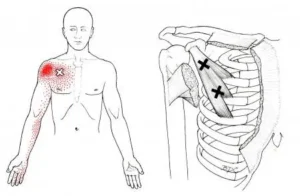
Relevant Anatomy and Etiology
The pectoralis minor is a thin, triangular muscle located beneath the pectoralis major. It originates from the 3rd to 5th ribs and attaches to the coracoid process of the scapula. In some cases, it even attaches into the rotator interval, between the rotator cuff tendons.
This muscle is primarily responsible for stabilizing the scapula and assisting in movements such as bench pressing, push-ups and dips.
It works closely alongside fellow stabilizers including the serratus anterior, rotator cuff, triceps, biceps and latissimus dorsi. Oftentimes, we will progress strength of all during rehabilitation.
Overuse insertional tendinopathy occurs when repetitive strain and poor technique lead to inflammation and pain at the muscle’s attachment point.
In weightlifters, particularly those who bench press frequently, this condition arises from training errors.
More specifically, a combination of higher training intensity and/or training frequency with insufficient rest and recovery. Biomechanical errors may also contribute.
The Do’s and Don’ts of Training with Pain
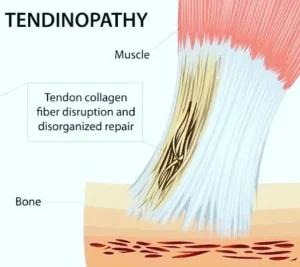
Tendinopathies, particularly insertional tendinopathies, are notoriously stubborn and tricky to treat.
Stretching in the early phase of rehabilitation can provide temporary pain but ultimately irritates the tissue and prolongs recovery.
Tendinopathies often require “just the right amount” of strength training to promote healing.
This is due to low circulation relative to bone and muscle tissue.
Injured lifters often find themselves trapped between two pathways, frequently alternating between them.
Pathway #1 – Avoidance: Avoiding / reducing your training can temporarily improve pain. However, it fails to reduce the degeneration and circulatory needs of the tissue.
The result? Greater weakness and disrepair with pain return as soon as you start liftinging again. (Often you will have pain at even lighter weights than before.)
OR
Pathway #2 – No Pain, No Gain: Training through the pain, thus irritating it even further.
A great physical therapist can help you find the right intensity or modification to allow you to return to benching at a tolerable level, promoting repair without irritation.
My Preferred Bench Press Modifications
Strategy 1 – Isometrics: Initiate a bench press (or push-up) isometric, gradually progressing deeper into the motion. Hold for 45 seconds, at a tolerable intensity for 3-4 sets.
Strategy 2 – Grip Variation: Modify to a narrower grip with arms abducted to 45 degrees, to place greater demand on the triceps.
Strategy 3 – Reduce Range of Motion: Begin lowering bar only to the halfway point to reduce aggravating forces at the bottom of the bench.
Strategy 4 – Lighter Weight, Slow Tempo: Begin at 50% your normal working weight. Perform a 3 second eccentric (lowering phase), a brief pause, and then a 3 second concentric (raising) phase.
Strategy 5 – Cross-Train Your Press: Opt for a dumbbell press, a decline variation, or use a chest press machine.
Strategy 6 – Combine Several of the Above: I will often start with strategies 1,3, and 4 by reducing the bench press by about 50%, and then having my athlete work in 50% depth (or whatever range they tolerate) for a 3 second eccentric and 3 second concentric. We will then cross train the press with support strategies.
If you’ve been struggling, seek expert advice.
If you’ve been dealing with persistent pain for more than three months, seek a healthcare provider’s advice.
Not sure where to turn? At KinetiQuest, we offer remote consultations and programming. Worst case scenario, we can help connect you with a provider if we’re unable to help you from a distance.
To your health,
Dr. Collin Christensen, PT, DPT
Physical Therapist, Board Certified Orthopedic Specialist, Strength & Conditioning Specialist
References:
- Bhatia et al. The “bench-presser’s shoulder”: an overuse insertional tendinopathy of the pectoralis minor muscle. Br J Sports Med. 2007 Aug;41(8):e11. DOI: 10.1136/bjsm.2006.032383. Epub 2006 Nov 30. PMID: 17138640; PMCID: PMC2465431.
- Bernstorff et al. Popular Gym Fitness Sport: An Analysis of 1387 Recreational Athletes Regarding Prone to Pain Exercises and the Corresponding Localizations. Sports (Basel). 2023 Dec 29;12(1):12. DOI: 10.3390/sports12010012. PMID: 38251286; PMCID: PMC10821116.
- Keith L. , Anne M. R . Clinically Oriented Anatomy seventh edition . Philidephia : Lippincott Williams & Wilkins.Feb 13, 2013.
- Castelein et al. Serratus anterior or pectoralis minor: Which muscle has the upper hand during protraction exercises?. Manual Therapy,April 2016: 22, 158–164.
Facebook
X
Email